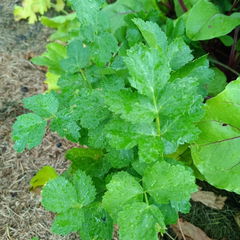
Endive ‘Escariol grüner’ – a Dutch landrace with robust autumn heads.
This open-pollinated, broad-leaved endive produces large, spreading, flattened heads with fleshy, medium-green leaves and a well-filled, yellow-green heart. The outer leaves have a pronounced, mildly bitter flavour, while the tender heart is considerably milder. Its strong tolerance of cool, wet autumn weather and its limited storage potential with the roots attached make this variety particularly valuable for late harvests. In Mediterranean climates, it is well suited to autumn and winter cultivation, while in Central European climates it is particularly suitable for late summer and autumn growing.
 Origin & History
‘Escariol grüner’ belongs to an old Dutch variety type known as ‘Breedblad Volhart Winter’. The type appeared under the name ‘Escariol, grüner’ in a German seed variety directory as early as 1912. Later European variety catalogues list ‘Escariol grüner’ alongside the names ‘Groene Volhart’, ‘Haarlems Volhart’, ‘Ronde verte à cœur plein’ and ‘Verde a cuore pieno’ as names for the same traditional variety. These different names reflect its spread across Germany, the Netherlands, France and Italy.
Dutch vegetable variety lists from the 1940s and 1950s described this type as particularly suitable for autumn cultivation outdoors and late growing under unheated glass. Its firmer leaves performed well in cool, wet weather, during transport and in short-term storage. The variety was also valued for preserving by salting, as its leaves shrink comparatively little during processing. Various selections of the original traditional variety were maintained, differing mainly in their uniformity. To this day, ‘Escariol grüner’ continues to be propagated as an open-pollinated, traditional heritage landrace for autumn and winter cultivation.
 Appearance & Characteristics
The plant forms a broad, spreading, flattened leaf rosette approximately 20–35 cm tall and 30–40 cm wide. Its outer leaves are loosely arranged to slightly upright, while the inner leaves close together to form a well-filled, paler heart. In the second year, branched flowering stems develop, usually reaching around 100–130 cm in height and bearing blue flower heads. Mature heads tolerate brief, light frosts down to around −5 °C, but protection is required during severe or prolonged frost.
Head details:
Size: Large, usually around 30–40 cm wide
Shape: Broad, rosette-shaped, slightly flattened and well filled
Color: Medium-green outer leaves with light green ribs and a yellow-green heart
Texture: Fleshy, firm and crisp, more tender in the heart
Flavor: Aromatic and mildly bitter, with a considerably milder, pale heart
 Usage & Cultivation Highlights
The crisp leaves are ideal for finely sliced endive salads and mixed leaf salads. The milder heart pairs well with fruit, nuts and robust dressings, while the more aromatic outer leaves can also be lightly steamed, braised or used in soups and stir-fries. In Mediterranean cuisine, escarole can be combined with ingredients such as pulses, garlic and olive oil. The firmer leaves are also suitable for pickling and fermenting. Heads harvested with their roots attached can be heeled in for a limited period in a cool cold frame or in moist sand.
The variety is particularly suitable for autumn cultivation outdoors and later crops in an unheated polytunnel or greenhouse. It develops reliably in cool weather and is more tolerant of wet autumn conditions than many more tender endive types, although it still requires well-drained soil without waterlogging. An even water supply encourages firm, tender leaves. The heart becomes paler naturally as a result of the dense growth. For an even milder flavour, dry heads that are almost ready for harvest can be tied together briefly or covered with an opaque material.
Compared with other endive varieties, ‘Escariol grüner’ stands out for its robust, fleshy leaves, good tolerance of cool, wet autumn weather and limited storage potential with the roots attached. Its large head combines aromatic outer leaves with a more tender, milder heart.