Leaf Celery 'Gewöhnlicher Schnitt' - Apium graveolens

$3.00 USD
$6,000.00 1kg
Price plus shipping
Delivery time: 1-2 business days (PT – international may vary)
reicht für ca. 10 m²

In stock

Historic variety. Open-pollinated & non-hybrid – 100% free from genetic engineering & synthetic fertilisers. Ecologically propagated – non‑proprietary variety.
Bohnensamen2

Harvest year:

2024

Seed viability:

Up to 4 years (species-specific)
Detailed information on germination capacity

Description

Cultivation & Characteristics

Leaf Celery ‘Gewöhnlicher Schnitt’ – aromatic celery leaves with an intense, savoury flavour.

This open-pollinated leaf celery variety produces an abundance of aromatic leaves with a strong, savoury and distinctly celery-like flavour. The plants grow bushily and produce fresh foliage after cutting, allowing leaves to be harvested as needed over many months. Its comparatively large leaves are suitable for fresh seasoning and can also be dried or frozen. Its vigorous growth and lower susceptibility to leaf spot diseases make this variety a proven culinary herb for garden beds, raised beds and containers. In Mediterranean regions, the milder growing periods are particularly suitable, while in Central European climates it provides a long harvest throughout summer and autumn.

  Origin & History

‘Gewöhnlicher Schnitt’ is a historic leaf celery variety known in the Netherlands as ‘Gewone Snij’. By 1943, it was already widely grown there as a high-yielding variety for spring cultivation outdoors and for the production of dried culinary herbs. Its traditional names also include ‘Lange Bos’ and ‘Grove Struik’. Even then, the variety was characterised by vigorous growth and by its larger leaves and stronger leaf stalks compared with fine-leaved types of leaf celery. These characteristics made it particularly suitable for producing larger quantities of aromatic celery leaves.

Its use as a dried herb remained an important part of its cultivation history for decades. Later Dutch cultivation recommendations also highlighted its good regrowth after cutting and high leaf production. The variety continued to be maintained in different conservation collections and also became established in German-speaking horticulture under its German name ‘Gewöhnlicher Schnitt’. Alongside its processing into a storable seasoning for soups, it continued to be used fresh as a culinary herb. Today, it is still propagated as an open-pollinated variety in organic seed production. Its strong leaf aroma, vigorous growth and ability to provide repeated harvests continue to define its character and distinguish it from particularly fine-leaved varieties of leaf celery.

   Appearance & Characteristics

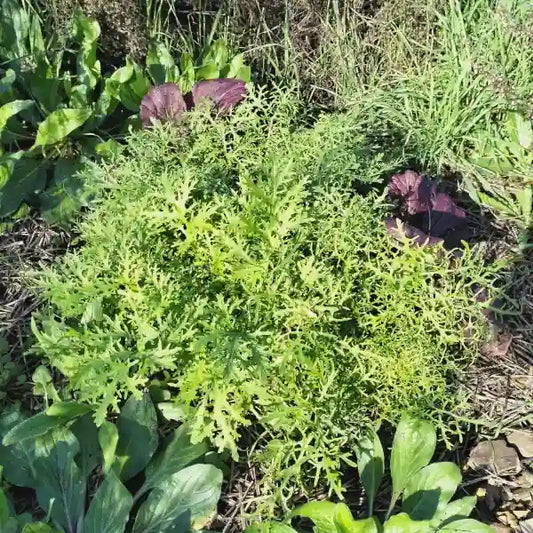
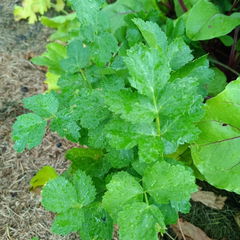
The plants develop an upright, bushy rosette with numerous slender, longitudinally grooved leaf stalks. The medium to dark green foliage is pinnate, with broad, distinctly toothed leaf segments. During the usual leaf-harvesting period, the variety reaches around 30–50 cm in height. It does not form a pronounced storage root. The plants tolerate light frost and can overwinter outdoors in mild, sheltered locations. Winter protection is recommended during severe or prolonged frost. In the second year, branched flower stalks around 60–90 cm tall develop, bearing small, whitish flowers in umbels.

Plant details:

  • Height: Medium, around 30–50 cm

  • Form: Upright, bushy and rosette-forming

  • Leaves: Pinnate, distinctly toothed and medium to dark green

  • Flowers: Small, whitish and arranged in umbels, appearing in the second year

  • Flavour: Intensely savoury, aromatic and characteristically celery-like

 Usage & Cultivation Highlights

The aromatic leaves and tender leaf stalks add flavour to soups, stocks, stews, sauces and vegetable dishes. Finely chopped, they are suitable for herb butter, dips, dressings, savoury fillings and pesto. Small amounts of fresh leaves also add a strong savoury flavour to salads. For a winter supply, the leaves can be dried or frozen in portions. When dried, they are particularly suitable for homemade herb salts and soup seasonings.

Repeated harvesting of the leaves provides a long period of use from a comparatively small growing area. Growing in pots and window boxes is also practical, allowing fresh celery leaves to be grown close to the kitchen. The variety grows in partially shaded as well as sunny positions and can therefore be incorporated flexibly into vegetable and herb beds. Compared with fine-leaved types of leaf celery, it is considered less susceptible to leaf spot diseases. In mild, sheltered locations, overwintering can extend leaf harvesting into the following spring.

Compared with other leaf celery varieties, ‘Gewöhnlicher Schnitt’ stands out for its more substantial foliage, vigorous growth and high leaf production. Its good regrowth after cutting and suitability for drying make it particularly useful for regular herb harvesting.

Cultivation_Overview_-_Anbau_im_Uberblick_-_Visao_geral_do_cultivo_-_www

Origin & Cultivation at a Glance

First mention:

1943

Origin:

Unknown

Breeder:

Unknown

Propagation site:

Hesse - Germany

Suitable for:

Open field, Greenhouse, Polytunnel, Cold frame, Raised bed, Balcony / pot, Urban gardening

Overwintering:

Overwinter frost-free in a bright position

Special features:

Quickly usable, Fast-growing, High-yielding, Resilient, Low-maintenance, Sun-loving / sunny, Shade-tolerant / partial shade, Heat-tolerant, Drought-tolerant, Cold-hardy
benjis-seeds-plant-growing-instructions-icon

Cultivation guide for

Leaf Celery 'Gewöhnlicher Schnitt'

Growing difficulty:

Light to medium

Care requirements:

Low – low-maintenance
This variety grows best in humus-rich, well-drained sandy loam with good water-holding capacity. Before sowing, loosen the soil, remove weeds and incorporate well-rotted compost. Prepare the surface to a fine tilth and avoid waterlogging.

For direct sowing, sow the seeds thinly in rows 30–40 cm apart on the moist soil surface. As they require light to germinate, firm them gently and do not cover them with soil. At 18–22 °C, germination usually takes 14–21 days. Keep the seedbed evenly moist during this period. Once the first pairs of true leaves have developed, thin the seedlings to 15–20 cm apart within the row. For sowing under cover, fill small trays with seed compost, moisten it and sow the seeds on the surface in the same way. Around 4–6 weeks after sowing, prick out individually into small pots or module trays. Plant out well-rooted young plants around 4 weeks later at the spacings given above, keeping the centre of the plant above soil level.

Water regularly during growth, remove weeds and loosen only the surface of the soil. After repeated harvesting, apply additional organic fertiliser as needed. Cut the outer leaves as required and leave the young central leaves intact so that the plants can regrow. For harvesting a larger area at once, cut the leaf stalks a few centimetres above ground level, leaving the centre of the plant undamaged.

Mediterranes Klima

In Mediterranean climates, we recommend direct sowing from February to April or from September to October in a sunny to partially shaded, airy and sheltered position. Sowing under cover in small trays is possible from January to March or from August to September, with the young plants planted out after around 8–10 weeks during mild weather. During hot growing periods, choose a position protected from strong midday sun and water consistently, as drought can restrict the production of new leaves. Spring sowings provide fresh foliage from late spring or summer onwards. After autumn sowing, harvesting is possible in areas with little frost throughout winter and until flowering begins the following spring. Protect the plants during severe frost.

Mitteleuropäisches Klima

In Central European climates, we recommend direct sowing from April to June in a sunny to partially shaded, airy and sheltered position. For an earlier harvest, sowing under cover in small trays from March to April in a bright, sufficiently warm position is recommended. Plant the young plants outdoors after around 8–10 weeks, from May to June, and avoid prolonged periods of cold while raising them, as these can encourage premature bolting. Water regularly during dry summer periods. Harvest the leaves as needed from late spring or summer into autumn. In sheltered positions, the plants can also be overwintered with winter protection for a further leaf harvest the following spring.

Cultivation tips:

• For a long harvest period, regularly pick outer leaves from the outside in - protect the heart to maintain growth.
• Good air circulation protects against aphids and fungal diseases.
• A layer of mulch keeps the soil evenly moist and suppresses weeds.
• Loosen only the surface of the soil to avoid damaging the roots.
• Removing flowers extends leaf usage.
• Bring pots indoors or into the greenhouse in autumn – this way the season can be significantly extended.

Storage instructions:

Store seeds in a cool, dry, dark, and airtight environment to maximize shelf life and germination.
Detailed information on seed storage
Plant_Profile_-_Pflanzen_Steckbrief_-_Ficha_da_planta_-_www

Plant Profile

Leaf Celery 'Gewöhnlicher Schnitt'

Plant details

Botanical name:
Apium graveolens L. 'Gewone Snij'
Botanical family:
Apiaceae - carrot family
Plant type:
Leafy vegetables
Growth habit:
Upright growth, Bushy, Herbaceous, Forms a rosette
Plant width:
25–35 cm
Plant height:
30–50 cm
Root type:
Taprooted, Shallow to moderately rooted
Hardy to:
Not winter-hardy, frost-sensitive.
Cultivation period:
4-6 months
Life cycle:
Biennial

Sowing & Planting

Germination type:
Light germinator
Sowing depth:
0 cm
Germination temperature:
18-22 °C
Germination time:
10-21 days
Pot culture:
Requires a minimum container size of 3 liters.
Row spacing for baby leaf:
10-15 cm
Plant spacing:
15–20 cm
Row spacing:
30–40 cm
Pricking out / thinning out:
Thin the seedlings within the row 4–6 weeks after sowing.
Planting time:
Transplanting not required - direct sowing is recommended.

Soil

Soil type:
Well-drained, humus-rich sandy loam soil
Soil pH:
6.5-7.5 - slightly acidic to alkaline
Nutrient requirements:
Moderate to heavy feeder
Soil moisture:
Evenly moist, Sensitive to waterlogging
Soil preparation:
Loosen soil before sowing, Apply compost before planting., Prepare soil weed-free and with a fine crumb structure., Mulch layer for moisture regulation

Companion planting, Crop rotation & Harvest

Companion plants:
Brassicas, Leek, Dwarf beans, Cucumber, Tomato, Spinach, Beetroot
Incompatible plants:
Potato, Corn
Crop rotation guidelines:
• Don't plant after other umbellifers – a minimum interval of 3 years is recommended.
• Avoid planting directly after heavy-feeding crops – allow the soil to recover and replenish nutrients first.
• Ideal previous crops include legumes, onions, root vegetables, and green manure – rotating crops supports healthy soil.
Sowing to harvest:
2-3 months
Harvested parts:
Leaves, Leaf stalks
Suitable for consumption:
Yes - edible raw.
Intended use:
Culinary herb, Raw consumption, Salad, Steaming, Cooking, Stuffing, To purée, Freezing, Drying / Dehydrating

Care & Cultivation practices

Water requirements:
High
Plant care techniques:
Thin out after germination when sown directly, Water regularly - even during dry periods, Loosen and hoe, Fertilize, Maintain weed-free
Plant protection:
Frost protection is recommended when frost is forecast, Slug protection recommended, Well-ventilated location and good drainage recommended., Mulching recommended
Cultivation notes:
Susceptible to slugs and snails in early development. Growth stops under drought – consistent water supply required. Sensitive to waterlogging – use well-drained soil. Cold conditions while raising young plants can trigger premature bolting.
Propagation method:
Generative propagation by seed
Propagation:
• This variety is pollinated by insects and belongs to the species Apium graveolens.
• For seed production, a minimum isolation distance of 150 m from other varieties of the same species is recommended.
• For seed saving, collect seeds from at least 60 healthy, true-to-type plants.
• Overwinter selected plants and allow them to flower in the second year.
• The seeds are ready to harvest once the umbels turn grey-brown and the seeds can be easily removed.
• Allow harvested umbels to finish drying in a well-ventilated place, rub out the seeds, clean them and dry them thoroughly.

Other names

EN - English names:

• Leaf celery • Cutting celery • Chinese celery

DE - German names:

• Leaf Celery • Blattsellerie • Gewürzsellerie

PT - Portuguese names:

• Aipo de folha • Aipo de corte • Aipo cortado • Aipo verde cortar

ES - Spanish names:

• Apio de hoja • Apio de cortar

FR - French names:

• Céleri à couper • Céleri feuille

Customer Reviews

Be the first to write a review
0%
(0)
0%
(0)
0%
(0)
0%
(0)
0%
(0)

Reviews in Other Languages

Further recommendations for you

Open-pollinated and reproducible