Leaf Celery ‘Gewöhnlicher Schnitt’ – aromatic celery leaves with an intense, savoury flavour.
This open-pollinated leaf celery variety produces an abundance of aromatic leaves with a strong, savoury and distinctly celery-like flavour. The plants grow bushily and produce fresh foliage after cutting, allowing leaves to be harvested as needed over many months. Its comparatively large leaves are suitable for fresh seasoning and can also be dried or frozen. Its vigorous growth and lower susceptibility to leaf spot diseases make this variety a proven culinary herb for garden beds, raised beds and containers. In Mediterranean regions, the milder growing periods are particularly suitable, while in Central European climates it provides a long harvest throughout summer and autumn.
 Origin & History
‘Gewöhnlicher Schnitt’ is a historic leaf celery variety known in the Netherlands as ‘Gewone Snij’. By 1943, it was already widely grown there as a high-yielding variety for spring cultivation outdoors and for the production of dried culinary herbs. Its traditional names also include ‘Lange Bos’ and ‘Grove Struik’. Even then, the variety was characterised by vigorous growth and by its larger leaves and stronger leaf stalks compared with fine-leaved types of leaf celery. These characteristics made it particularly suitable for producing larger quantities of aromatic celery leaves.
Its use as a dried herb remained an important part of its cultivation history for decades. Later Dutch cultivation recommendations also highlighted its good regrowth after cutting and high leaf production. The variety continued to be maintained in different conservation collections and also became established in German-speaking horticulture under its German name ‘Gewöhnlicher Schnitt’. Alongside its processing into a storable seasoning for soups, it continued to be used fresh as a culinary herb. Today, it is still propagated as an open-pollinated variety in organic seed production. Its strong leaf aroma, vigorous growth and ability to provide repeated harvests continue to define its character and distinguish it from particularly fine-leaved varieties of leaf celery.
 Appearance & Characteristics
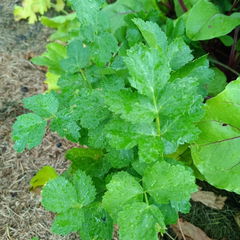
The plants develop an upright, bushy rosette with numerous slender, longitudinally grooved leaf stalks. The medium to dark green foliage is pinnate, with broad, distinctly toothed leaf segments. During the usual leaf-harvesting period, the variety reaches around 30–50 cm in height. It does not form a pronounced storage root. The plants tolerate light frost and can overwinter outdoors in mild, sheltered locations. Winter protection is recommended during severe or prolonged frost. In the second year, branched flower stalks around 60–90 cm tall develop, bearing small, whitish flowers in umbels.
Plant details:
Height: Medium, around 30–50 cm
Form: Upright, bushy and rosette-forming
Leaves: Pinnate, distinctly toothed and medium to dark green
Flowers: Small, whitish and arranged in umbels, appearing in the second year
Flavour: Intensely savoury, aromatic and characteristically celery-like
 Usage & Cultivation Highlights
The aromatic leaves and tender leaf stalks add flavour to soups, stocks, stews, sauces and vegetable dishes. Finely chopped, they are suitable for herb butter, dips, dressings, savoury fillings and pesto. Small amounts of fresh leaves also add a strong savoury flavour to salads. For a winter supply, the leaves can be dried or frozen in portions. When dried, they are particularly suitable for homemade herb salts and soup seasonings.
Repeated harvesting of the leaves provides a long period of use from a comparatively small growing area. Growing in pots and window boxes is also practical, allowing fresh celery leaves to be grown close to the kitchen. The variety grows in partially shaded as well as sunny positions and can therefore be incorporated flexibly into vegetable and herb beds. Compared with fine-leaved types of leaf celery, it is considered less susceptible to leaf spot diseases. In mild, sheltered locations, overwintering can extend leaf harvesting into the following spring.
Compared with other leaf celery varieties, ‘Gewöhnlicher Schnitt’ stands out for its more substantial foliage, vigorous growth and high leaf production. Its good regrowth after cutting and suitability for drying make it particularly useful for regular herb harvesting.